Devyora CRM — Sales & Operations Software
Back to work
Case study·Custom Software / CRM

Devyora CRM — Sales & Operations Software

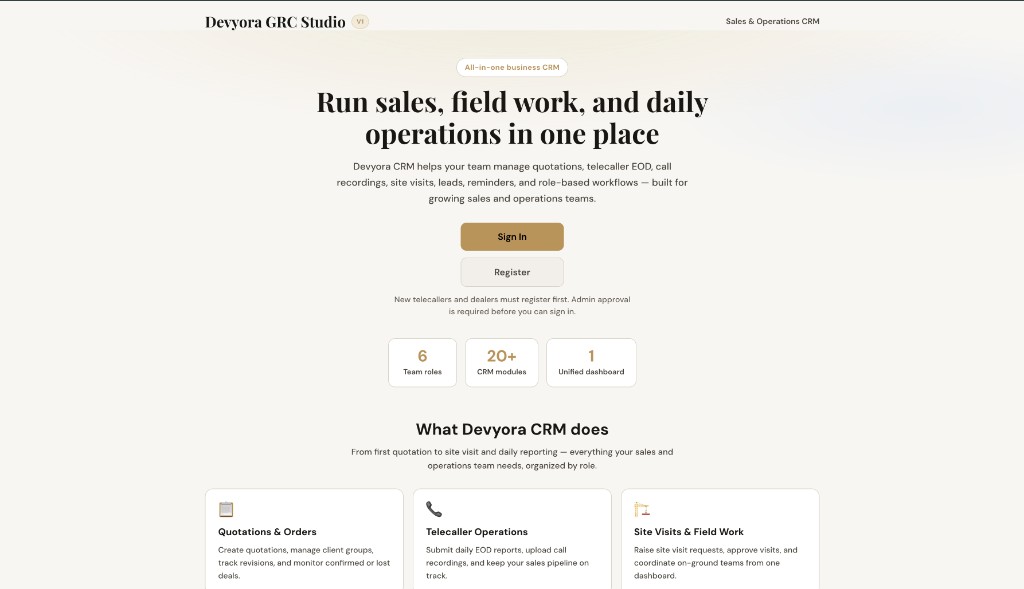
Devyora GRC Studio is a custom-built CRM that helps growing sales and operations teams run everything from first quotation to site visit and daily reporting — organized by role. Telecallers, dealers, and field staff register, get admin approval, then work inside modules tailored to their responsibilities, all measured through a single dashboard.

CRMCustom SoftwareReactAuthRole-Based AccessDashboardBusiness Automation
At a glance

Project highlights

Role-based access for 6+ team roles: admin, telecaller, dealer, field staff, and more

Quotations & orders: create quotes, manage client groups, track revisions, and monitor confirmed vs lost deals

Telecaller operations: submit daily EOD reports, upload call recordings, and manage the sales pipeline

Site visits & field work: raise visit requests, approve visits, and coordinate on-ground teams from one place

Leads, reminders, and role-based workflows across 20+ CRM modules

Registration + admin approval flow so new telecallers and dealers are vetted before access

Unified dashboard for real-time visibility into team activity and outcomes

Deep dive

How we approached it

01

Custom business software, not a template

Devyora CRM is bespoke operations software built around how a real sales and field team works. Instead of forcing a generic CRM, it models the actual pipeline: quotations and orders, telecaller daily reporting, call recording uploads, site-visit requests and approvals, leads, and reminders — all gated by role. The result is one place to run sales and operations rather than a stack of spreadsheets and chat groups.

02

Role-based access and approvals

The platform supports 6+ distinct roles with different permissions and views. New telecallers and dealers register first and must be approved by an admin before they can sign in, keeping data and pipeline access controlled. Each role lands in workflows relevant to them — telecallers in EOD and calls, field staff in site visits, admins in oversight and configuration.

03

Quotations, orders, and pipeline

Sales users create quotations, organize clients into groups, track quote revisions, and monitor which deals are confirmed versus lost. This turns the quotation-to-order journey into structured, reportable data instead of scattered documents, so managers can see conversion health at a glance.

04

Telecaller operations and reporting

Telecallers submit daily end-of-day (EOD) reports, upload call recordings for quality and accountability, and keep their pipeline moving inside the CRM. Standardized reporting means managers get consistent daily signal on activity and outcomes without chasing manual updates.

05

Site visits and field coordination

Field work is handled as a first-class module: teams raise site-visit requests, admins or managers approve them, and on-ground staff are coordinated from a single dashboard. This closes the loop between office-based sales and field execution, which is often where operations teams lose visibility.

06

Unified dashboard and stack

Everything rolls up into one unified dashboard spanning 20+ CRM modules, giving leadership a real-time view across roles. Built as a modern web application with secure authentication, role-based routing, and cloud hosting, the system is designed to scale as new roles, modules, and workflows are added.

Want something similar?

Share your sector, timeline, and goals — we'll propose a stack and roadmap that fits.